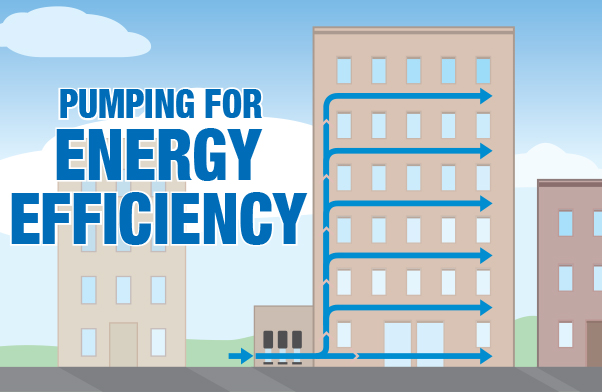
In many applications, the energy required for pumping can be a significant portion of total energy costs. Anything from manufacturing to buildings for housing apartments or offices will require pumps to boost pressure throughout the facility.
Since piping is expensive, the pipes are often a smaller diameter which requires increasing pressure to overcome the losses due to the smaller pipe. When shifting piping cost reductions to pumping costs, it is important to use all tools available to pump efficiently, which will result in lower power costs.
Consider a building in which the maximum flow will be 140 gpm at 180 psi, much of which is to overcome piping losses. For most of the time, less than maximum flow is needed. Actually, many building profiles expect maximum flow to only be needed about 1% of the time. To illustrate we will look at three optional methods of operation.
- The pump selected will run full flow continuously, bypassing when maximum flows are not needed. A 20 hp pump will be needed and if operated 24 hours, 7 days a week it will require 123,230 KWH per year. At $0.10/KWH that is $12,323 per year in energy costs.
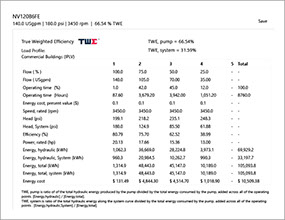
- Using the same pump and valves to match the actual flow profile of the building. We will use a profile for chillers that calculates load varying throughout a day on a chiller system. If the pump is applied to this profile, the pump load is calculated at 100%, 75%, 50%, and 25% of maximum flow. Using a valving system to control this pump would result in a yearly energy use of 105093KWH or at $0.10/KWH, $10,509 per year. A savings of $1,800 as shown in the chart in image 1 below.
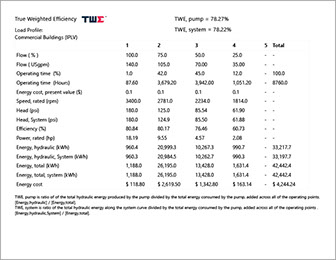
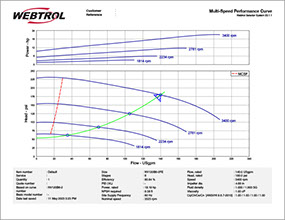
- Again, using the same pump so that we can meet the maximum flow conditions, we will add a variable frequency drive (VFD) to the device to control the flow to the facilities requirements. As the flow requirements go down, the VFD slows the motor down, which decreases flow and the associated piping losses. This can be seen in image 3 below depicted by the green line. Throughout the range of the four duty points, a KWH requirement is calculated and totaled for the entire day. Calculations used in the same load profile are shown in the chart in image 2 below. As seen on the calculations the annual KWH usage is now 42440KWH or $4,244 at $0.10/KWH. This is a savings of over $8,000 from the first method.
Government agencies and energy conservation groups are strongly urging new installations to be much more energy efficient. Facility owners are also becoming energy efficient. With savings of over $4,500 per year on energy alone in this case, the lifetime savings on the system are significant. Notice on the profile images the letters TWE. TWE refers to True Weighted Efficiency, which is a measurement of overall efficiency within a profile. By comparing TWE of various pumps using the same profile, the higher TWE will be more efficient.
In the examples the TWE without a drive was 66.54% while adding the VFD to the profiled performance increased TWE to 78.27%. Pump sizing programs such as Intelliquip have software to calculate the TWE for you for various profiles, including an option for a custom profile which can be created by the user. TWE is also the method used by the US Department of energy to produce energy ratings for pumps.
The Intelliquip program can be found at webtrol.portal.intelliquip.com and can help you calculate your profiles.