
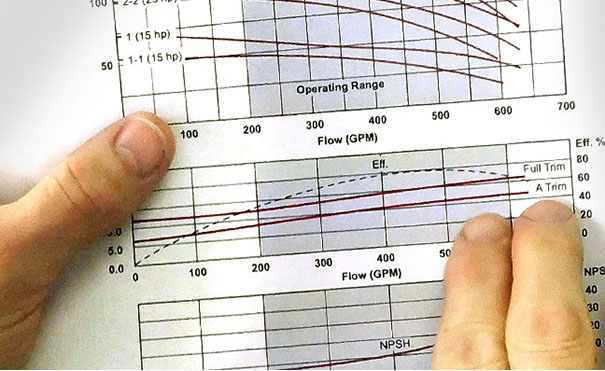
The cost of energy, as well as government mandates have made pumping efficiently more important than ever. Pumping efficiency, not the horsepower of the motor, is the critical parameter for a centrifugal or booster pump.
Centrifugal pumps have a performance curve associated with the pump. This curve contains the efficiency of the pump at various flows within the pumps range. Carefully reviewing this curve is a crucial step when selecting a pump.
A common term is “Best Efficiency Point” (BEP) which is the flow at a point where efficiency is highest. Matching the pumps requirements to the BEP assures that the pump is working at its most efficient point on the curve.
Manufacturers and engineers often recommend using the pump at flows of between 80% and 110% of the flow at BEP. If flow drops below this percentage, radial imbalance begins to occur. This causes shaft deflection which in turn can cause pre-mature failure to mechanical seals as well as the bearings and may cause shaft breakage which will add to the cost of maintenance and any associated downtime.
Surprisingly, flows above the 110% of BEP range can also be damaging. Higher flows decrease the suction pressure which can cause cavitation. Flows outside the range may also cause the motor input watts to go into service factor. Continuous operation in service factor conditions will shorten the motor life.
Sizing pumps to match BEP to the pumping conditions is beneficial in considering lifetime cost of pumping. Not only do you reduce energy cost per gallon pumped, but additional savings occur since the cost of maintenance is less. It is common in lifetime cost of a pump calculations that we find the initial cost of a pump is an insignificant amount when energy and maintenance costs are added.
At Webtrol, qualified customer service personnel and salespeople can help you in selecting the right pump for your needs. Call us direct at 800-769-7867 for assistance. Consider Webtrol for quality products and service.